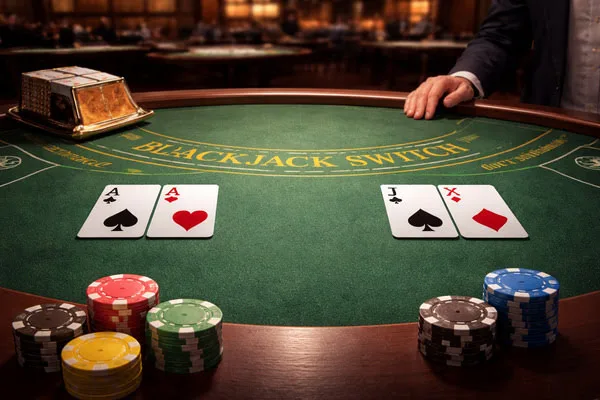
Blackjack Switch is a variation of classic blackjack in which the player places two equal bets and receives two separate hands in the same round. The defining rule is simple but unusual: after the initial deal, the player may switch the top cards between those two hands. This changes the rhythm of the blackjack switch game and creates decisions that do not exist in standard blackjack. For anyone asking what is blackjack switch, the shortest answer is this: it is a faster, more tactical version of blackjack built around card swapping, adjusted payouts, and a different strategic approach.
The format may look familiar at first, but the underlying logic is different. A strong opening hand can become average after a switch, while two weak hands can turn into a far more playable combination. Because of that, players who want to play blackjack switch online should not rely on habits learned from regular blackjack alone. The rules, the value of certain totals, and even the way risk is assessed all shift once the switch option enters the game.
How Blackjack Switch Works: Core Mechanics
To understand how to play switch blackjack correctly, it is important to break down the mechanics step by step. The game may look similar to classic blackjack at first glance, but the presence of two hands and the option to switch cards changes how each round unfolds. Every stage, from the initial deal to the dealer’s final action, is structured to support this core feature, which is why even familiar elements behave slightly differently here.
These mechanics are not just technical details; they directly affect decision-making. Players must evaluate two hands simultaneously, consider the impact of switching, and anticipate how the dealer’s rules influence outcomes. This makes the blackjack switch game more dynamic, especially for those who prefer analysing situations rather than relying on fixed patterns of play.
Number of Decks and Table Setup
Most blackjack switch tables use six or eight decks, which is standard for many modern blackjack variations. The table itself looks close to a normal blackjack layout, but each player position has room for two active hands instead of one. That detail matters from the very start because the game is designed around comparing, improving, and managing both hands at the same time rather than treating each round as a single isolated decision.
The dealer runs the round in much the same way as in ordinary blackjack, but the presence of two hands per player adds another layer to every action. In a live setting, this makes the round visually clear: two betting spots, two hands, one decision point for switching. In blackjack switch online, the layout is usually even easier to follow because the interface highlights which cards are eligible for swapping and shows the updated totals immediately after the move.
Two Hands and Equal Bets
A player must begin by placing two identical wagers. This is not optional and it is one of the structural rules that defines the game. You are not playing one hand with an occasional bonus feature; you are playing two linked hands that create a single tactical situation. The switch option only exists because both hands belong to the same player, so equal betting keeps the format balanced and prevents the rule from being exploited through uneven stake sizing.
This requirement also changes how players think about value. In ordinary blackjack, one strong hand can carry the round. Here, the aim is often to improve the overall quality of both hands together. A move that slightly weakens one hand may still be correct if it creates two playable totals instead of one strong hand and one weak one. That is one reason the blackjack switch game appeals to players who enjoy decision-making more than routine play.
Dealing Process
The opening deal follows a set order. Each of the player’s two betting spots receives a face-up card, and the dealer receives one face-up card. Then a second face-up card is dealt to each player hand, while the dealer takes a second card face down. At this point, the player can see both starting hands and the dealer’s upcard, which provides the information needed to decide whether a switch improves the position.
This moment is central to how to play switch blackjack correctly. The decision is made before normal action continues, so the player must evaluate structure, not just raw totals. Two hands worth 13 and 8 may look mediocre, but after a switch they could become 10 and 11, which are far more flexible. The game therefore rewards players who read starting combinations carefully rather than reacting only to the visible total on each hand.
Card Switching Mechanism
The switching feature is what defines blackjack switch and separates it from any other blackjack variation. After receiving two cards in each hand, the player is allowed to exchange the top cards between those hands. It is important to note that only one card from each hand can be swapped, which keeps the mechanic controlled and prevents players from completely rebuilding their hands.
This rule creates a unique layer of decision-making. The goal is not always to form the highest possible total in one hand, but to improve the overall balance between both hands. In many cases, two medium-strength hands offer better chances than one strong hand and one weak one. This is where blackjack switch strategy begins to differ significantly from traditional blackjack thinking.
Player Decisions and Turn Order
Once the switching decision is complete, each hand is played separately using standard blackjack options such as hit, stand, double, and split. Typically, the right hand is played first, followed by the left. This order matters because decisions made on the first hand do not affect the second one directly, but they do influence how the player approaches the rest of the round.
Players who want to play blackjack switch effectively should understand that switching is only the beginning of the strategy. The quality of decisions after the swap often determines the final outcome. A good switch can still lead to poor results if follow-up actions are not aligned with the dealer’s visible card and the structure of the new hands.
Dealer’s Actions After Players
After all players complete their actions, the dealer reveals the hidden card and continues according to the house rules. In most cases, the dealer must hit on soft 17, although some variations require standing instead. This detail has a measurable effect on probabilities and should always be checked before starting a session.
For players exploring blackjack switch online, understanding dealer behaviour is essential. The switch mechanic may improve initial hands, but the final result still depends on how the dealer completes their hand. A solid understanding of both player options and dealer rules ensures that decisions remain consistent throughout the game.
Switch Blackjack Rules Explained
Although blackjack switch shares many similarities with traditional blackjack, several rule adjustments are introduced to balance the advantage created by card switching. These rules affect payouts, dealer behaviour, and certain player options, making it essential to understand them before starting to play blackjack switch online or in a live setting.
The structure of the game is built around compromise. While the player gains flexibility through switching, the casino offsets this with specific limitations. As a result, switch blackjack rules should always be considered as a complete system rather than a simple extension of classic blackjack.
Standard Rules in Most Casinos
Most blackjack switch games are played with six or eight decks and follow standard dealing procedures. The dealer typically hits on soft 17, which slightly increases the house advantage compared to standing on soft 17. These base conditions are important because they influence how often the dealer improves their hand and how aggressively the player should act.
Another key point is that the game includes the so-called Push 22 rule. If the dealer reaches a total of 22, all active player hands result in a push instead of a loss, unless the player has a natural blackjack. This rule significantly changes risk evaluation and is one of the main reasons why blackjack switch basic strategy differs from standard blackjack strategy.
Doubling and Splitting Conditions
In many versions of the blackjack switch game, players are allowed to double down on any two cards, which provides flexibility after a favourable switch. Splitting is also generally permitted when the player receives two cards of the same rank, and in some cases, resplitting is allowed up to multiple hands. These options increase the number of possible decisions within a single round.
However, players should be cautious when applying standard habits. The presence of the Push 22 rule and even-money payouts changes the expected value of these moves. A decision that is considered optimal in classic blackjack may not produce the same result here, which is why understanding the specific switch blackjack rules is essential.
Insurance Bet Feature
When the dealer shows an ace, players may be offered the option to place an insurance bet. This side wager protects against a dealer blackjack but functions independently from the main hands. In blackjack switch, the presence of two hands does not change the underlying mathematics of insurance, which remains a separate decision.
Because the game already includes additional complexity through switching, some players may feel tempted to use insurance more often. However, it should still be approached carefully and based on understanding rather than impulse. Maintaining discipline in these situations is part of building a consistent blackjack switch strategy.
Blackjack After Switching
One of the most important differences in blackjack switch is how blackjack hands are treated after a swap. If a player forms a blackjack through switching, it is not considered a natural blackjack. Instead, it is counted as a regular total of 21, which receives even money rather than the traditional 3:2 payout.
This rule is a direct balancing factor. Without it, the ability to rearrange cards could create too many high-value hands. For players, this means that while switching can improve consistency, it does not increase the payout potential of top hands in the same way as classic blackjack.
Rule Variations Across Casinos
Different casinos may apply slight variations to the standard rules. Some may allow the dealer to stand on soft 17, while others may include options such as late surrender. These differences may seem minor, but they can affect the overall dynamics of the game and should always be checked before playing.
When choosing where to play blackjack switch online, it is useful to review these rule variations carefully. Even small adjustments can influence strategy and long-term outcomes, especially for players who aim to approach the game with a structured and informed mindset.
Example of Card Switching in Practice
To better understand how the blackjack switch game works, it is useful to look at a practical example. The switching option may seem straightforward, but its real value becomes clear only when you see how it transforms weak or average hands into more flexible positions. This is especially important for players learning how to play switch blackjack, as the correct decision is not always obvious at first glance.
The key idea is to evaluate both hands together rather than separately. A player should focus on how the swap affects the overall situation instead of trying to maximise one hand only. In many cases, balanced hands lead to more consistent outcomes than uneven combinations.
Initial Hands
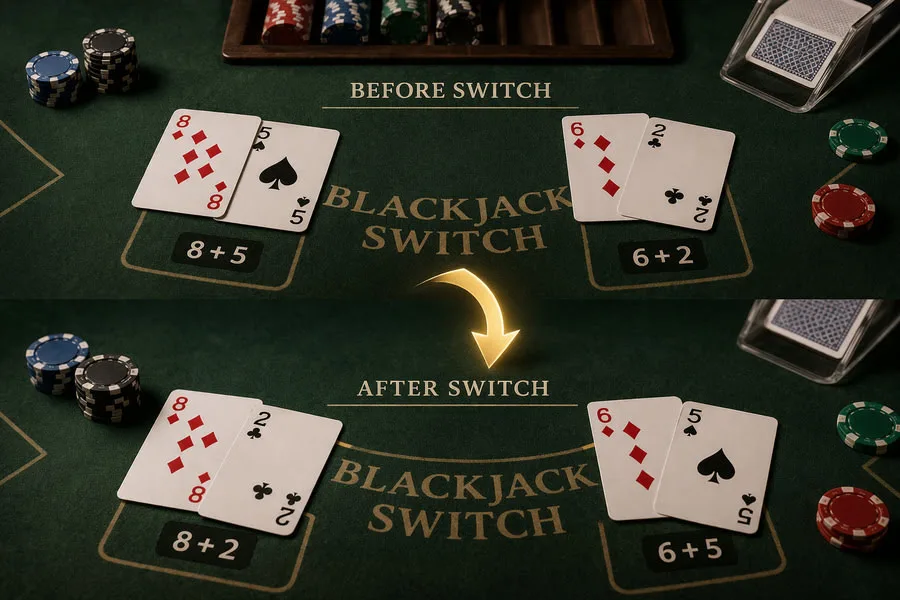
Imagine a player is dealt two hands: one contains a 5 and an 8, while the other consists of a 6 and a 2. At first glance, these hands produce totals of 13 and 8, which are not particularly strong, especially against a dealer’s upcard such as 8. In a standard blackjack scenario, both hands would require cautious play and could easily lead to weak outcomes.
At this stage, the player has the option to switch the top cards between the two hands. This is where blackjack switch becomes more strategic, as the decision is based not only on current totals but also on potential improvement after the swap.
After the Switch
By exchanging the top cards, the player now creates two new hands: 5 and 2, and 8 and 6. This results in totals of 7 and 14 initially, but if arranged correctly, it can also produce combinations leading to 10 and 11 depending on card order interpretation in some scenarios. More importantly, the hands become more playable compared to the original setup.
This transformation highlights the purpose of switching. Instead of being stuck with two awkward hands, the player reshapes the situation into one where both hands offer clearer decision paths. In blackjack switch online, this process is often displayed visually, making it easier to understand how the swap changes the outcome.
Why Switching Improves Odds
The main advantage of switching is not just increasing the total value of a hand, but improving its potential against the dealer. Two moderate hands often provide more opportunities to react correctly to the dealer’s upcard than one strong and one weak hand. This balance reduces the risk of losing both bets in a single round.
From a strategic perspective, blackjack switch strategy focuses on creating flexibility. Hands such as 10 or 11 allow for doubling, while totals around 12–16 can be managed depending on the dealer’s card. The more flexible both hands are, the better the player’s chances of navigating the round effectively.
Best Moves After Switching
Once the switch is complete, the player should evaluate each hand individually while still considering the overall outcome. Strong totals like 10 or 11 are often good candidates for doubling down, while weaker hands may require hitting to improve their position. The correct choice depends on the dealer’s visible card and the structure of both hands.
Players who want to play blackjack switch online successfully should treat the switch as the beginning of the decision process, not the final step. Consistent results come from combining a good swap with disciplined follow-up actions, which together form the foundation of effective play.
Blackjack Switch Basic Strategy
Blackjack switch basic strategy differs from traditional blackjack because of the additional layer introduced by card switching. While the goal remains to beat the dealer, the path to that goal changes significantly. Players must think in terms of two hands at once and consider how each decision affects the overall balance of the round.
The presence of rules such as Push 22 and even-money payouts for blackjack further shifts optimal play. As a result, standard blackjack charts are not reliable in this format. A dedicated blackjack switch strategy is required to make consistent and informed decisions.
Differences from Classic Blackjack Strategy
In classic blackjack, decisions are usually made based on a single hand and the dealer’s upcard. In blackjack switch, players must evaluate how two hands interact with each other. This often leads to different choices, especially when deciding whether to prioritise one strong hand or improve both hands equally.
The ability to switch cards introduces scenarios where traditional logic does not apply. A player might intentionally avoid creating a very strong hand if it results in leaving the second hand too weak. This balance-based thinking is one of the core elements that define blackjack switch strategy.
When to Hit, Stand or Double
Decisions such as hitting, standing, or doubling down depend on both the hand total and the dealer’s upcard. However, in blackjack switch, these decisions are also influenced by the relationship between the two hands. A player may choose a more conservative line if both hands are moderately strong, or take a more aggressive approach if one hand needs improvement.
Understanding these dynamics is essential for players who want to play blackjack switch effectively. The goal is not simply to follow fixed rules, but to interpret each situation based on the available information and the structure of both hands.
Keep hands balanced after switching
Avoid creating one strong and one weak hand
Double down more often on totals of 10 or 11
Be cautious with splitting due to Push 22 rule
Impact of Push 22 Rule
The Push 22 rule changes how risk is evaluated. If the dealer reaches 22, all player hands push instead of losing, which reduces the penalty for certain aggressive plays. This often leads to situations where hitting on marginal totals becomes more acceptable compared to standard blackjack.
As a result, players may take slightly higher risks in order to improve their hands, knowing that the worst-case outcome is sometimes softened by this rule. This adjustment is a key part of blackjack switch basic strategy and should not be overlooked.
Why Standard Strategy Does Not Work
Using a traditional blackjack strategy chart in blackjack switch can lead to incorrect decisions. The differences in payouts, rules, and hand structure mean that expected values are not the same. What works in one version of the game may produce suboptimal results in another.
For players aiming to improve their performance, it is important to study strategies specifically designed for blackjack switch. This ensures that decisions are aligned with the actual mechanics of the game rather than assumptions carried over from other formats.
Side Bets in Blackjack Switch
In addition to the main gameplay, many blackjack switch tables offer optional side bets. These bets are separate from the primary wagers and are based on specific card combinations formed at the start of the round. While they may seem attractive due to higher payouts, they function independently from the standard blackjack switch game and should be considered carefully.
Side bets are typically simple to understand but come with a different risk profile. Players who explore blackjack switch online will often encounter these options, especially in digital versions where additional features are more common. Understanding how they work helps avoid confusion and supports more informed decisions during play.
What is Super Match
One of the most common side bets in blackjack switch is called Super Match. This bet is based on the four cards dealt to the player at the beginning of the round, across both hands. The goal is to form specific combinations such as pairs or sets, which are evaluated independently of the dealer’s final hand.
The appeal of Super Match lies in its simplicity. Players do not need to follow complex rules or strategies, as the outcome is determined immediately after the initial deal. However, this simplicity also means that the bet relies purely on probability, without any influence from player decisions.
Example Payouts
The payouts for Super Match depend on the type of combination formed by the initial four cards. While exact values may vary slightly between casinos online, the general structure is consistent and reflects the rarity of each combination.
Combination
Example Payout
Pair
1:1
Two Pairs
8:1
Three of a Kind
5:1
Four of a Kind
40:1
These payouts illustrate how the reward increases with the rarity of the combination. While higher payouts may appear attractive, they are balanced by lower probabilities, which is why side bets generally carry a higher house edge compared to the main game.
Why Side Bets Have a Different RTP
Side bets in Blackjack Switch have a different RTP from the main game because their results are based on separate probability models. The main hands involve several player decisions, including switching, hitting, standing, doubling, and splitting. A side bet such as Super Match is determined by the initial four cards and does not allow the player to influence the outcome after the cards have been dealt.
The payout structure also affects the mathematical return. Less common combinations, such as four of a kind, offer much larger payouts than frequent results such as a single pair. However, the higher reward reflects the lower probability of receiving that combination. This balance between frequency and payout determines the theoretical return of the side bet and explains why it should be analysed separately from the RTP of the main Blackjack Switch game.
In practice, side bets generally carry a higher house edge than the standard wagers. This does not change how the main Blackjack Switch hands are played, since the side bet is settled independently. Players comparing game conditions should therefore distinguish between the mathematical return of the core game and the return associated with optional bets rather than treating them as part of the same probability structure.
Are Side Bets Worth It
From an analytical perspective, side bets like Super Match are optional and not essential for enjoying blackjack switch. They add variety and can create moments of higher payouts, but they do not improve the long-term expected outcome for the player. For this reason, many experienced players treat them as occasional additions rather than a core part of their approach.
Players who choose to use side bets should do so with a clear understanding of their purpose. They are best viewed as entertainment features rather than strategic tools, especially when compared to the decision-based nature of the main blackjack switch game.
Blackjack Switch Card Counting
Card counting is often associated with traditional blackjack, but its application in blackjack switch is more complex. While it is theoretically possible to track card distribution, the presence of two hands and the switching mechanic introduces additional variables that make the process more challenging.
Players interested in blackjack switch card counting should understand that the method requires more than basic counting skills. It involves adapting traditional systems to a format where outcomes are influenced by both hand interaction and rule variations.
Is Card Counting Possible
In theory, card counting can be applied to blackjack switch in a similar way to standard blackjack. By tracking the ratio of high to low cards remaining in the deck, players can estimate when the odds shift slightly in their favour. However, the effectiveness of this approach depends heavily on the specific conditions of the game.
In practice, many modern games, especially in online environments, use frequent reshuffling or continuous shuffling systems. This significantly reduces the usefulness of counting and limits its practical application in blackjack switch online.
Why It Is More Complex
The complexity of card counting in blackjack switch comes from the need to evaluate two hands at once while also accounting for the impact of switching. Each decision affects the structure of the round, which makes it harder to apply standard counting models without adjustments.
In addition, rule variations such as Push 22 and modified payouts further influence probabilities. These factors mean that even experienced players must adapt their approach significantly when attempting to apply counting techniques in this format.
Two hands must be tracked simultaneously
Switching changes expected outcomes
Push 22 rule affects probabilities
Deck penetration is often limited
Online Game Limitations
In online versions of blackjack switch, card counting is generally ineffective due to frequent reshuffling. Many digital games reset the deck after each round, which prevents players from building a reliable count over time. This makes traditional counting strategies largely impractical in most online settings.
For players exploring blackjack switch online at NolimitWay, it is more practical to focus on understanding the rules and applying a consistent blackjack switch basic strategy. This approach provides a more stable foundation for decision-making than relying on methods that depend on deck tracking.
 Svenska
✓
Svenska
✓
 English
✓
English
✓
 български
✓
български
✓
 Čeština
✓
Čeština
✓
 Dansk
✓
Dansk
✓
 Deutsch
✓
Deutsch
✓
 Ελληνικά
✓
Ελληνικά
✓
 Español
✓
Español
✓
 Eesti
✓
Eesti
✓
 Suomi
✓
Suomi
✓
 Français
✓
Français
✓
 Italiano
✓
Italiano
✓
 Latviešu valoda
✓
Latviešu valoda
✓
 Norsk Bokmål
✓
Norsk Bokmål
✓
 Polski
✓
Polski
✓
 Português
✓
Português
✓
 Română
✓
Română
✓
 Slovenčina
✓
Slovenčina
✓
 Slovenščina
✓
Slovenščina
✓
 Türkçe
✓
Türkçe
✓
 Íslenska
✓
Íslenska
✓
 中文 (香港)
✓
中文 (香港)
✓
 Español
✓
Español
✓
 Français
✓
Français
✓
 日本語
✓
日本語
✓
 한국어
✓
한국어
✓
 Bosanski
✓
Bosanski
✓
 Português
✓
Português
✓
 Hrvatski
✓
Hrvatski
✓
 Magyar
✓
Magyar
✓
 Lietuviškai
✓
Lietuviškai
✓
 Nederlands
✓
Nederlands
✓
 Tagalog
✓
Tagalog
✓
 Español
✓
Español
✓